How Activated Carbon Works in Water Filtration Systems
It’s been quite some years since activated carbon in water filtration systems has been proven to be effective. Be it industrial liquid waste or municipality, this substance does the job without breaking a sweat. The only reason that makes it immensely efficient is its high adsorption capacity, which we all know.
In this article, we will take a deep dive into the actual working principle of Activated Carbon in water filtration systems. It might help you navigate through your application/setup and make an informed decision on your filtration investment.
Position of Activated Carbon in a Water Filtration System
The pore size of the Activated Carbon that you are procuring from the market matters to your application. Generally, granular Activated Carbon, which comes in a size range from 0.5 to 4 mm, is used in this scenario. Once that is sorted, positioning it in your application makes all the difference.
You station activated carbon post-sedimentation basins, where turbidity drops below 5 NTU. This safeguards micropores from rapid plugging by suspended solids. In comprehensive batches, it precedes ultrafiltration or RO arrays.
Once you strategically do the early placement, it manages broad-spectrum organics after oxidation stages like ozonation. AC’s mid-process roles guard ion exchange from fouling precursors. For your scale-up accuracy, you can strategize the positioning via pilot Metronidazole (MTZ) data.
Ultimate positioning refines final effluent, ensuring compliance specs. Hydraulic profiling, on the other hand, dictates precision slotting. Thus, you can conclude that placement directly impacts overall process and media longevity.
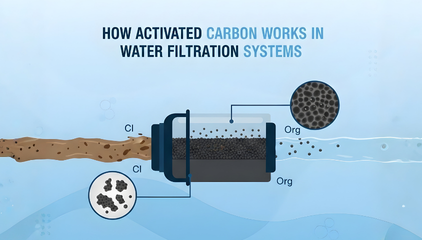
What Happens When Water Passes Through Activated Carbon
When water is passed through the activated carbon filter, its highly porous surface captures all the impurities seamlessly.
In other words, the phenomenon is connected to Van Der Waals forces that take place between molecules. This interaction is the feeblest of all intermolecular forces that hold molecules together. The force that takes place here is short-ranged and is sophisticated between the carbon surface and the adsorbate molecule.
With this methodology, Activated Carbon effectively removes organic pollutants, chlorine, and disagreeable odours from drinking water, substantially boosting water quality.
Adsorption in Water Filtration
In the above section, we’ve already discussed the adsorption process, which is nothing but ̶ the way in which Activated Carbon traps impurities in flowing water. Since we know that Activated Carbon is produced specially so as to achieve a very big internal surface (between 500 – 1500 m2/g). This vast surface area makes activated carbon for water filtration, the go-to material, due to its vast surface area.
Here’s a quick list of the soluble substances that Activated Carbon captures, if present in water:
- For organic, non-polar substances like:
- BTEX
- Chloride
- Mineral Oil
- Poly aromatic hydrocarbons (PACs)
- Adsorption of halogenated substances: Br, CI, F, I, etc.
- Odor and taste
- Yeasts
- Numerous fermentation products
- Non-polar substances (which are non-soluble in water)
Take note that the activity level of adsorption is based on the concentration of the substance in water, the temperature, and the polarity of the substance.
Role of Carbon Particle Form in Filtration Performance
The role of carbon particles matters when it comes to the ultimate filtration performance of the activated carbon you have incorporated. Now, you must know that powdered Activated Carbons (particle size: 10 – 100 µm) and granular Activated Carbons (0.2 – 1.5 µm, or sometimes up to 2.5 mm) are the two main types.
- PACs are applied as dry powder or as a slurry. In the former form, it is dosed with dry feed equipment. Subsequently, it is incorporated for low-dose applications and for infrequent applications.
For slurry, it is dosed with metering pumps. It is used when PAC is added more frequently and when high doses are needed.
- You’ll find GACs being applied in post-filtration stages. Consider a conventional filtration process, or inside a granular medium filter, where a segment of the filter bed is replaced by GAC.
So, in the post-filtration setup, the GAC filter receives good-quality water because the water has already passed through the complete treatment process.
Water Filtration Scenarios Using Activated Carbon
Water filtration using activated carbon is mainly seen in three broad categories:
- Drinking water treatment: when activated carbon water filter is used, it removes chlorine, volatile organic compounds (VOCs), unpleasant odors, and taste-causing substances, improving water quality and safety.
- In industrial wastewater treatment, Activated Carbon helps eliminate organic contaminants, residual disinfectants, and chemical impurities that may interfere with manufacturing processes.
- Treatment plants, like those in municipalities: used during secondary or tertiary filtration stages to polish water, reduce micropollutants, and enhance overall treatment efficiency before distribution or discharge.
Final Takeaway
There is no doubt that activated carbon for water filtration will stay in the market for the years to come and for all the right reasons. Its adsorption capacity makes it an eternal solution that filters substantial impurities (both domestic and industrial) within budget and on scale.
Since 2011, our team at Austro Carbon has specialized in manufacturing a wide range of activated carbon varieties for diverse applications. We strive to meet almost all international standards (ASTM, BIS, EU, and AARL) to cater to our clientele within India and 10+ other countries.
Reach out to us today if you are seeking high-end activated carbon for your water treatment needs.