Activated Carbon Filters in Water Treatment Plants
Over the last decade, the usage of activated carbon filters in wastewater treatment has gone up by several notches. According to the latest report of Fortune Business Insights, the AC market (Mercury control) is projected to grow from USD 1.38 billion in 2026 to USD 2.27 billion by 2034.
Now, the reason behind this exponential rise in AC usage is due to its high efficiency and optimum pricing. The efficiency relates to its adsorption capabilities (trapping contaminants), and pricing gets justified since the raw materials are generally coconut shells or wood-based.
Founded in 2011, Austro Carbons has been the torchbearer when it comes to manufacturing and exporting a wide range of AC products. Thus, with our experience, we’ve curated this article so that industrialists like you can best implement the correct AC filters in their filtration systems.
What Entails an Activated Carbon Water Filtration System?
The AC filtration process uses adsorption as its method of removal; whereas absorption has one material moving into another, the AC filter uses adsorption by trapping contaminants along the surface of activated carbon (AC).
When passing water through an AC filter, organic materials (including chlorine, chloramines, pesticides), and offensive odors (such as cigarette smoke) are adsorbed into the extremely porous structure of the granules of activated carbon, resulting in a greatly reduced concentration of contaminants in your water. Typically, these filters can be used as pre-filters and post-filters prior to using reverse osmosis (RO) or ultraviolet (UV) purification in an industrial application.
How Activated Carbon Filters Work
There is a structured methodology of carbon filters in a smooth industrial ecosystem:
- Pre-filtration: The water goes through pre-filtration to remove large, suspended solids. This prevents premature carbon bed blocking.
- The Adsorption Step is where the water flows through an activated carbon bed for removing the majority of impurities. This happens because the enormous surface area of activated carbon allows for the trapping of impurities as the clean water passes through.
- Post-Filtration: The treated water exits the system, ready to be utilized industrially or distributed.
The major part of the secret of removing impurities is in the surface area of activated carbon. A gram of activated carbon can have an area larger than 1,000 square metres. Thus, the surface area provides a very large area to capture impurities.
Industrial Water Treatment with Activated Carbon
The usage of AC filters in industrial water treatment spans across varied sectors like:
- Chemical industry
- Food & Beverages industry
- Pharmaceuticals
- Manufacturing units
We will get into the applications in depth, later in this column, but if your factory setup falls under any of these categories, you should understand that AC filtration is used in the final stages after processes like sedimentation and flocculation.
Government regulations like ETPs and periodic compliance submissions have made all these industries sort out their wastewater treatment. And this large-scale treatment is being met with high-end AC filters.
Wastewater Treatment with Activated Carbon
Now three distinct formats of AC are being used in the industries mentioned in the earlier section:
- Powdered AC: These are generally 0.18mm in size and help in rapid adsorption due to their fine structure. It’s suitable for emergency treatments and helps remove color, odor, and bad tastes.
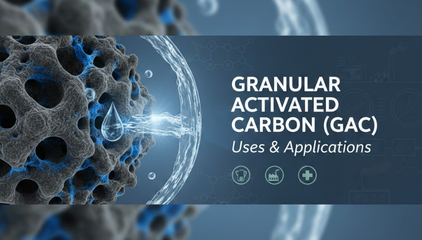
- Granular AC: larger, irregular particles that are packed into fixed-bed filters/columns. Appropriate for large-scale industrial purification systems.
- Pelletized AC: comes in cylindrical pellets with uniform size and shape. Gas treatment and solvent recovery procedures root for this type of carbon.
Why Coconut Shell Activated Carbon Is Preferred
You will see that when searching for superior performance and efficiency, coconut shell based activated carbon is usually the preferred choice. Coconut shell AC has the advantage of having very high hardness, so that it can endure the pressures of continuous filtration systems without fracturing or breaking down.
It offers a very high capacity to adsorb micro-pollutants, meaning you will get a consistently high-quality result each time it is used. In addition, the ash content of a coconut shell AC is naturally low.
Benefits of Activated Carbon Filters
Your transition to or maintenance of activated carbon systems brings several advantages:
- A good AC filter has high adsorption efficiency in trapping contaminants, which clocks upto 90%.
- It eliminates chlorine, organics, bad odor, and taste.
- It serves as a highly cost-effective solution for industrial-scale operations. Blends seamlessly with your system; zero hassle.
- It is a reliable, time-tested method that bridges the gap between efficiency and necessity.
Applications
AC filters are versatile enough to be used in a wide range of industrial applications:
- In Municipal water treatment plants for effluent check
- Industrial processes for the protection of membranes and ion exchange systems
- In wastewater treatment facilities wherein elimination of chlorine, taste, odor, and organic matter is paramount.
- The F&B sector implements heavily to decolorize, deodorization and impurity removal (BOD/COD, fats, greases, etc.)
- In core manufacturing processes, to trap heavy metals, lubricants, and coolants.
- In pharma manufacturing centres, to remove APIs, antibiotics, etc.
Final Takeaway
It’s 2026, and AC filtration methodology in varied industrial sectors has become more vital. Decision makers in these factory setups have reported that these filtration systems are not only cost-effective but also meet the regulatory standards.
If you are still confused about which AC filter or activated carbon type to invest in, our team at Austro Carbon would be happy to clarify. Our dedicated R&D team ensures that you get high-end activated carbon products that have passed international standards (ASTM, AARL, EU, and BIS).